How to Choose a Kids Tennis Coach in the Eastern Suburbs: A Parent's Checklist
Accreditation, group size, and how a club handles the trial lesson tell you more than price or postcode ever will.
With a handful of clubs and coaches across the Eastern Suburbs and South Sydney all offering junior tennis, picking one isn't always straightforward. Here's what actually matters when you're evaluating a coach or club for your child, regardless of which one you end up choosing.
The Short Answer: What to Look For
The things that matter most are Tennis Australia accreditation, a sensible coach-to-player ratio, coaching that's genuinely scaled to your child's age and stage rather than one-size-fits-all, and the ability to try a session before committing to ongoing enrolment. Location and price matter too, but they're secondary to whether the coaching itself is actually good for your specific child.
Tennis Australia Accreditation: The First Thing to Check
Tennis Australia runs a tiered coach accreditation system, with entry-level qualifications for junior/development coaching through to Club Professional and Performance-level tiers for advanced and competitive coaching.1 This matters because "coaching kids" and "being good at tennis" aren't the same skill; an accredited coach has specifically trained in how to teach the sport to children, including age-appropriate progressions and safe technique development, not just how to play it well themselves. It's completely reasonable to ask a club directly what accreditation level their coaches hold, and a club confident in its coaching should have no issue answering clearly.
Coach-to-Player Ratio and Group Size
A smaller group means more individual attention, more actual ball-hitting time per child, and less time standing in line waiting for a turn. There's no universally "correct" ratio, younger or newer players generally benefit from smaller groups than older, more experienced ones, but it's worth asking directly rather than assuming. A club that's vague about typical group sizes, or won't tell you how many kids are usually in a session, is worth a second look.
Age and Stage-Appropriate Coaching
Good junior coaching doesn't use full-sized courts, standard balls and adult-style drills for a five-year-old. Look for a program structured around modified courts, scaled equipment (smaller racquets, softer/slower balls) and stage-based progression, rather than a single format applied to every age. This is also a good way to judge whether a club has actually invested in junior coaching specifically, rather than treating kids' classes as a smaller version of adult lessons.
Location and Logistics for Eastern Suburbs Families
Distance and timing sound like secondary concerns compared to coaching quality, but in practice they're often what determines whether a family sticks with a program long-term. A slightly less convenient club can still be worth it if the coaching is genuinely better, but for most families, a club with sensible parking, a schedule that fits around school and other activities, and a location that doesn't turn a 45-minute lesson into a 90-minute round trip will simply get used more consistently.
Try Before You Commit
Any club confident in its coaching should be comfortable letting you and your child try a session before signing up for an ongoing program. A trial lesson tells you far more than a website ever can: how the coach actually talks to kids, whether your child is engaged or bored, and whether the group size and pace feel right in practice. Be cautious of any program that pushes for a full-term commitment before you've seen a single session.
Communication and Progress Visibility
Ask how the club communicates with parents: is there any feedback on how your child is progressing, a clear point of contact if you have a question or concern, and visibility into what stage or level your child is currently at. This doesn't need to be formal or elaborate, but a coach or club that can tell you specifically how your child is developing (not just "they're doing great!") is generally paying closer attention than one that can't.
This becomes more important the longer your child stays in a program. In the first few weeks, most parents are mainly checking whether their child is enjoying themselves. A few months in, it's reasonable to expect a coach to be able to answer more specific questions: which stage your child is progressing toward, what they're working on technically, and roughly how that compares to a typical timeline for their age. A club that can only offer general reassurance, rather than anything specific, may simply not be tracking individual progress closely.
Red Flags Worth Noticing
A few things worth being cautious about when evaluating any club:
- Reluctance to let you watch a session or trial before committing
- Vague or evasive answers about coach qualifications
- No clear structure or progression between skill levels
- Pricing or contract terms that aren't transparent upfront
None of these alone is necessarily disqualifying, but if you notice more than one, it's worth asking more questions before enrolling.
It's also worth paying attention to how a club handles a bad-fit conversation. Not every child clicks with every coach or program straight away, and a club that's upfront about that, rather than pretending every child adapts instantly, is generally being honest with you rather than just trying to close an enrolment. Ask what happens if your child tries a program and it's clearly not working: is there flexibility to switch groups, pause, or get a straight answer about whether it's worth persisting, or does the conversation stay entirely focused on getting you to sign up regardless.
What This Looks Like at Mutch Park
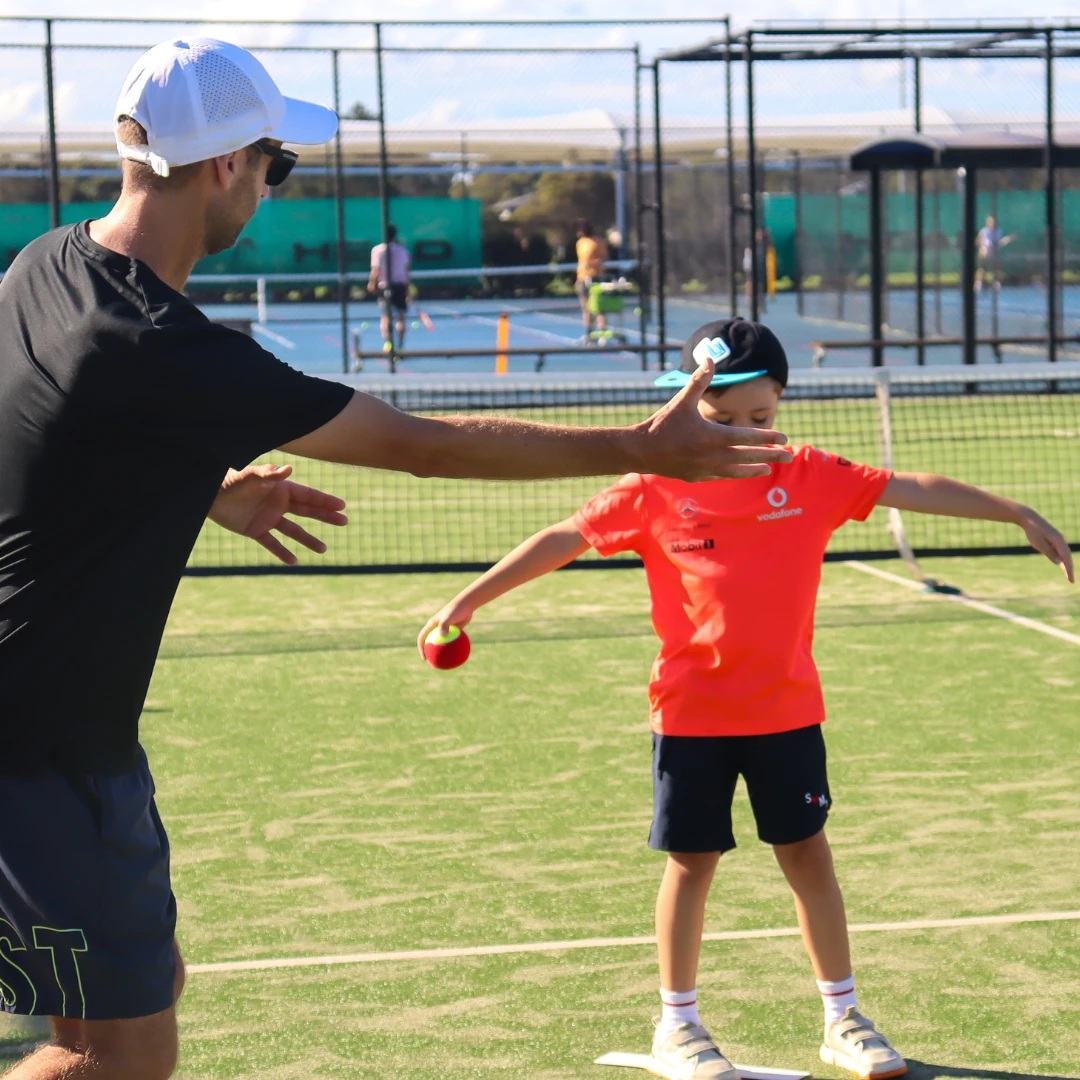
For context on how we approach this ourselves: Mutch Park's Hot Shots program follows the Tennis Australia framework, with coaching staged from Kinder through Yellow Ball based on skill rather than age alone, using scaled courts, balls and racquets at every level. Lead coach Craig Christopher holds Tennis Australia's Level 3 elite coaching qualification, and every family can book a free trial lesson before enrolling in an ongoing program, so you can see exactly how a session runs before committing to anything.
FAQs
What qualification should a kids tennis coach have?+
Look for Tennis Australia accreditation, ideally at least a junior/development-level qualification, since this specifically covers how to teach tennis to children rather than just playing ability. Higher tiers (Club Professional, Performance) generally indicate more advanced or competitive coaching training.
How big should a kids tennis class be?+
There's no single correct number, but smaller groups generally mean more individual attention and ball-hitting time. It's worth asking any club directly what their typical group size is rather than assuming.
Should I be able to watch or trial a lesson before enrolling?+
Yes. Any club confident in its coaching should be comfortable with a trial session or letting you watch before you commit to an ongoing program.
What's the difference between kids and adult tennis coaching?+
Good junior coaching uses modified courts, softer or slower balls, and smaller racquets scaled to a child's age and stage, rather than adult-format drills. This matters more for younger or newer players than for teenagers close to adult-level play.
What questions should I ask a club before enrolling my child?+
Ask about coach accreditation level, typical group size, whether a trial session is available, and how they communicate with parents about a child's progress. A club that answers these clearly and specifically is a good early sign.
Is a more expensive club always better coaching?+
Not necessarily. Price doesn't reliably indicate coaching quality on its own; accreditation, group size, and how well the coaching is scaled to your child's age tell you more than cost alone.
Next Steps
The best way to judge any club, including Mutch Park, is to see a session for yourself. If you'd like to see how our Hot Shots program runs in practice, you're welcome to bring your child along to a free trial lesson.
Sources: (1) Tennis Australia, coach qualification and accreditation levels, tennis.com.au/doc/qualifications. Mutch Park's own coach credentials sourced from the club's own About Us page.